What Qualifies for Urgent Tree Removal Service?
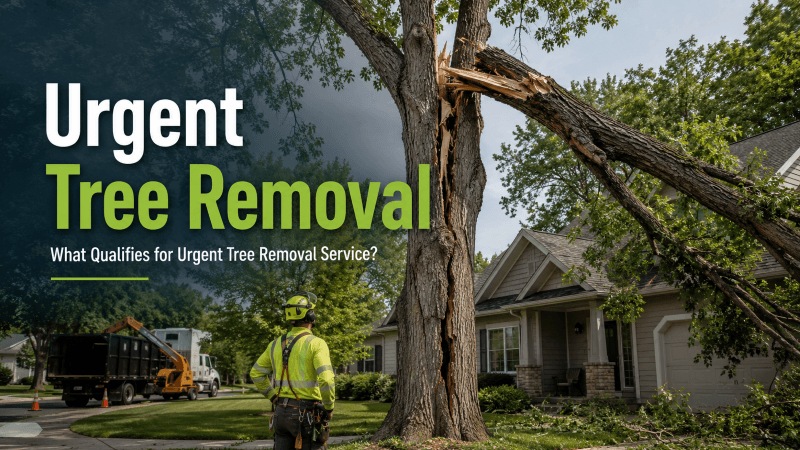
Summary: Urgent Tree Removal is needed when a tree or major limb creates an immediate safety risk to people, homes, vehicles, driveways, sidewalks, or utility access. Trees with sudden lean, major trunk cracks, uprooted roots, storm damage, or large hanging limbs often require fast professional assessment and, in many cases, prompt removal.
Homeowners often ask what truly counts as Urgent Tree Removal and what can wait a few days. In simple terms, urgency comes down to immediate risk. If a tree is broken, unstable, leaning suddenly, resting on a structure, or threatening people or property, it moves from a maintenance issue to a safety issue. At Minnesota Tree Experts, we help homeowners sort out that difference quickly and safely.
When a Tree Problem Becomes Urgent
Not every unhealthy tree needs same-day removal. Some trees can be monitored, pruned, braced, or scheduled for routine removal. The situation becomes urgent when failure appears likely in the near term and there is a target nearby, such as a home, garage, driveway, sidewalk, deck, or play area. ISA’s tree risk guidance notes that split, torn, or broken branches should be addressed, and serious structural defects can require professional mitigation or removal.
Arbor Day Foundation resources also emphasize that risk is not only about tree condition. It is also about where the tree stands and what it could hit if it fails. A dead limb over an empty woodland trail is different from a dead limb over your front door.
Top Signs You May Need Urgent Tree Removal
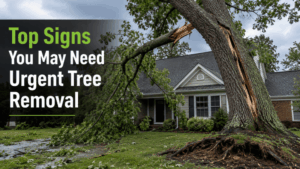
1. The tree has developed a sudden lean
A tree that has leaned for years may not be an emergency. A tree that recently started leaning is different. U.S. Forest Service hazard tree guidance lists recent lean, root lifting, soil movement, and mounding near the base as high-risk indicators because they suggest compromised anchoring.
If you see fresh cracking soil, roots lifting from the ground, or a tree tipping toward your house, call for professional help right away. Do not try to cut or stabilize it yourself.
2. A major limb is split, hanging, or broken
Broken and hanging branches are among the clearest urgent hazards, especially after storms. ISA notes that split, torn, or broken branches should be removed, and Penn State Extension advises homeowners to contact a qualified arborist to remove storm-damaged limbs or trees.
A branch that is caught in the canopy can fall without warning. That risk rises if the limb hangs over a driveway, roof, or sidewalk.
3. The trunk is cracked or splitting
Deep vertical cracks, fresh trunk splits, or stems pulling apart often mean the tree’s structure has been compromised. In some cases, cabling or bracing may help, but ISA cautions that not all weak trunks or limbs are candidates for support systems. Some trees are simply too unstable and require removal.
Homeowners should assume a fresh structural split is serious until a certified arborist says otherwise.
4. The tree or limb is on a home, vehicle, or blocking access
Once a tree is resting on a roof, garage, fence, or car, the problem becomes urgent even if the wood is not fully broken. The same applies when a tree blocks emergency access, a road, or a primary walkway. Arbor Day sample ordinance language describes dead, dying, obstructive, or hazardous trees that threaten public safety as nuisance conditions that may require removal.
If power lines are involved, stay away and call the utility company or 911 first.
5. The tree is dead and positioned to hit something important
Dead trees do not always need immediate removal in remote areas, but dead trees near homes, patios, play spaces, or driveways often do. U.S. Forest Service materials note that dead and dying trees, hanging limbs, and snag hazards are well-documented causes of serious injury when they fall or collapse
If the tree is fully dead and within striking distance of your home or a neighbor’s property, do not wait for the next wind event to make the decision for you.
Helpful Homeowner Guidance Before the Crew Arrives
One of the most useful things a homeowner can do is recognize what not to do. Do not climb the tree. Do not stand under hanging limbs. Do not use a ladder and chainsaw near cracked trunks or tensioned wood. Penn State Extension recommends working with an ISA Certified Arborist for storm-damaged limbs and trees because the hazards are often greater than they appear from the ground.
Take clear photos from a safe distance. Note whether the lean is new, whether roots are lifting, and whether any structures are affected. This can help with both scheduling and insurance documentation.
If the problem is urgent, go directly to our contact page or review our Tree Removal page to understand how the service works.
What Does Not Always Qualify as Urgent Tree Removal?
Some tree problems feel alarming but do not always require same-day removal. A tree with slow decline, interior deadwood, minor fungal growth, or long-term lean may still need work, but not emergency work. Arbor Day Foundation and ISA materials both point out that risk assessment often includes alternatives to removal, such as pruning, inspection, or periodic monitoring.
That said, delay should only happen after a qualified assessment. A tree can look stable to a homeowner and still have hidden decay or root failure.
Unique and Helpful Tips for Homeowners Facing Urgent Tree Removal
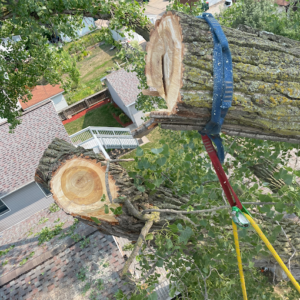
First, document everything. If a storm caused the damage, take photos before cleanup begins, as long as it is safe. Second, know that “cutting it down fast” is not the same as removing it safely. Tight spaces, front-yard removals, and trees over structures often require rigging, sectional dismantling, and stump grinding planning. Third, avoid anyone who suggests topping as a quick fix. Penn State Extension warns that tree topping leads to poor structure and greater future storm damage.
Another helpful point is this: urgent removal is often about location as much as condition. A partially dead elm in the back of a large lot may be a scheduled project. The same elm over a front sidewalk may be urgent.
When you want a clearer picture of overall care options beyond removal, our Services Page outlines the broader tree work we provide.
Customer Experience with Minnesota Tree Experts
Fast response matters, but so do professionalism and cleanup. Here is a recent 5-star Google review from a Minnesota Tree Experts customer:
“Great price! Had a great experience with Minnesota Tree experts. Eric and Racheal and the crew did an awesome job removing an elm tree from my front yard and grinding the stump. They were very fast, professional, and cleaned up everything really well. Would definitely recommend!”
— Steve, 5-Star Google Review
Services: Tree stump grinding, Tree removal
Front-yard removals are often the jobs homeowners worry about most because of visibility, access, and cleanup. Our goal is to make the process safe, efficient, and as low-stress as possible.
FAQ: Urgent Tree Removal
What qualifies as urgent tree removal?
Urgent Tree Removal usually means the tree or a major limb poses an immediate risk to people or property. Common examples include a recent lean, trunk split, broken hanging limb, uprooted base, or a tree resting on a house, vehicle, or access route.
Should I remove a tree immediately after storm damage?
Not always, but you should have it assessed quickly. Some storm-damaged trees can be pruned or stabilized. Others are too unsafe to leave standing. Hanging limbs, root lifting, and trunk splits are strong reasons to call right away.
Can a leaning tree be saved instead of removed?
Sometimes. A long-term lean may be manageable, but a recent lean with disturbed soil or lifted roots is much more serious. A certified arborist must assess whether pruning, support, or removal is the safer option.
What should I do if a tree is touching power lines?
Stay away and keep others away. Do not touch the tree or try to move branches yourself. Call the utility company or 911 first, then arrange professional tree service after the area is declared safe.
Does every dead tree require urgent removal?
No. Dead trees in remote areas may be monitored or scheduled later. Dead trees near homes, driveways, play areas, or sidewalks are more likely to need urgent removal because the consequences of failure are much higher.
Need Fast Help Deciding If Your Tree Is an Emergency?
When a tree looks dangerous, waiting often adds risk. If you see a sudden lean, a split trunk, hanging branches, or a tree threatening your home, act early and act safely.
Minnesota Tree Experts is here to help you sort out whether you are dealing with routine maintenance or true Urgent Tree Removal. Visit our Home page, review our Tree Removal page, explore our Services Page, or go straight to our contact page to request help. The sooner a dangerous tree is assessed, the sooner your property can be made safe.

Published: June 2026