Should I Grind a Tree Stump Before Winter in Minnesota?

Stump Grinding Minnesota property owners schedule before winter can improve safety, appearance, and future landscaping options. Fall stump grinding can remove tripping hazards before snow hides them. It can also make spring lawn and landscape projects easier. Professional stump grinding is preferred because equipment, underground utilities, stump size, roots, and surrounding structures all affect the job.
Frequently Asked Questions About Stump Grinding Before Winter

Should I grind a tree stump before winter in Minnesota?
Yes, fall can be an excellent time to remove an unwanted stump before snow covers the property.
Grinding removes a visible obstacle and prepares the area for future lawn or landscaping work.
Can stump grinding be done in cold weather?
Stump grinding can often continue during cool fall weather before the ground becomes deeply frozen.
Conditions vary, so scheduling earlier in fall usually provides greater flexibility.
Why should businesses remove stumps before snow arrives?
Snow can hide stumps near walkways, parking areas, landscaped islands, and maintenance routes.
Removing them can reduce obstacles for pedestrians, snow removal equipment, and property maintenance crews.
Will grinding a stump remove the entire root system?
No. Stump grinding removes the main stump and usually grinds portions below ground level.
Many deeper roots remain underground and gradually decompose.
Can I plant another tree in the same place after stump grinding?
Possibly, but planting directly within the old stump location can create challenges.
Remaining roots, wood chips, and changing soil conditions can affect a new tree.
A professional can help determine a better nearby planting location.
Does stump grinding prevent tree regrowth?
Grinding greatly reduces the stump, but some tree species can produce shoots from remaining roots.
Professional evaluation can help determine whether additional treatment or monitoring is appropriate.
Is professional stump grinding safer than renting a grinder?
Professional service is generally preferred because stump grinders are powerful machines with fast-moving cutting components.
Professionals also consider underground utilities, access, slopes, buildings, fencing, and nearby landscape features.
How soon after tree removal should the stump be ground?
A stump can often be ground shortly after tree removal once site conditions allow.
Combining removal and stump planning can create a cleaner, more complete project.
Why Fall Is a Smart Time to Deal With an Old Stump
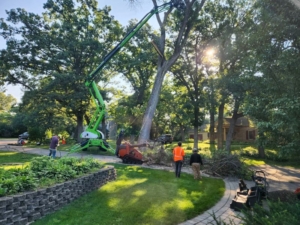
Tree removal often solves the most urgent problem on a property. However, the remaining stump can create its own set of concerns. Those concerns become easier to overlook once snow arrives. A stump can disappear beneath several inches of snow while remaining a solid obstacle underneath. Fall provides an opportunity to address that problem while the site remains visible and accessible. It also gives homeowners more options for spring landscaping.
Benefits of Stump Grinding Minnesota Properties Before Winter
Stump Grinding Minnesota property owners schedule in fall can provide several practical benefits.
| Reason to Grind | Why It Matters Before Winter | Long-Term Benefit |
|---|---|---|
| Reduce tripping hazards | Snow can hide low stumps from pedestrians. | Creates a safer and more usable yard. |
| Help snow removal | Hidden stumps can interfere with plows or snowblowers. | Creates clearer maintenance routes. |
| Improve appearance | Fall cleanup can leave the property looking finished. | Removes an obvious remnant of tree removal. |
| Prepare for spring | The major obstacle disappears before winter. | Allows faster lawn or landscape planning. |
| Improve mowing access | The stump will not remain in the mowing path next season. | Reduces repeated trimming around the stump. |
| Reduce unwanted growth | Some stumps may continue producing sprouts. | Grinding can simplify long-term site management. |
A Tree Stump Becomes Harder to See Under Snow
One of the strongest reasons for fall stump grinding involves visibility. A stump that appears obvious in September can become nearly invisible by January. This matters around homes with children, pets, visitors, or frequently used walking paths. It can matter even more on commercial properties. Employees and customers may cross landscaped areas without knowing a stump sits beneath the snow. Snow removal crews may also encounter stumps while clearing parking lots or sidewalks. Removing the obstacle before winter can simplify property maintenance.
Stump Grinding Is Different From Stump Removal
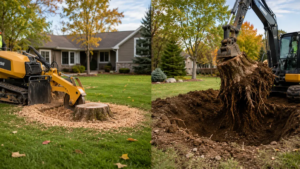
Property owners sometimes use “stump grinding” and “stump removal” as interchangeable terms. They describe different approaches. Grinding uses specialized equipment to mechanically reduce the stump into smaller wood material. The operator generally grinds the stump below the surrounding soil level. Full stump removal attempts to remove much more of the root mass. That method can create substantially more soil disturbance. For many residential and commercial properties, grinding provides a practical solution with less disruption.
Why Professional Stump Grinding Is Preferred
A stump grinder is not simply a large lawn tool. It uses a powerful rotating cutting wheel designed to break apart dense wood. Conditions around the stump can complicate the work. Nearby fences, buildings, driveways, patios, retaining walls, and landscape beds can restrict equipment access. Buried utilities create another important consideration. Roots can also grow around rocks, concrete, irrigation components, or underground structures. Professional crews evaluate the entire work area before grinding begins. Minnesota Tree Experts provides stump grinding as part of its comprehensive residential and commercial tree care services. You can review additional service information on the Minnesota Tree Experts FAQ page.
What Happens to the Roots After Stump Grinding?
Grinding does not normally excavate every root extending from the original tree. Most large trees have root systems extending well beyond the trunk. After grinding, remaining roots usually break down naturally over time. That decomposition can gradually change the soil around the former stump location. This matters when homeowners plan a garden, patio, lawn repair, or replacement tree.
Think Ahead Before Planting Another Tree
Replacing a removed tree can be a great long-term property improvement. However, planting a new tree directly inside the old stump location may not be ideal. Old roots still occupy space beneath the ground. Wood chips can also change soil conditions as organic material decomposes. New trees need adequate soil volume and room for developing roots. A nearby location may provide better growing conditions. Consider the future tree’s mature size, utilities, buildings, sidewalks, and property boundaries before planting.
What Should Happen to the Wood Chips?
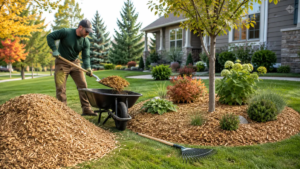
Stump grinding produces a mixture of wood chips and soil. Property owners often assume the material can immediately become normal planting soil. That is not always the best approach. A large concentration of fresh woody material can temporarily affect nitrogen availability during decomposition. The University of Minnesota Extension provides guidance on using wood chips in landscapes. Wood chips can be useful mulch when used appropriately. However, the final plan should match what you want to do with the former stump area.
Watch for Sprouting Around Old Stumps
Some tree species respond aggressively after the main trunk is removed. Shoots may emerge from the stump or remaining root system. Grinding removes the main stump but does not always eliminate every living root immediately. Homeowners should monitor the area for new growth. Repeated sprouts may require additional professional attention depending on the species and site. If the original tree showed disease or unusual decline, consider professional tree diagnostics for surrounding trees.
Tree Removal and Stump Grinding Work Best as One Plan
When possible, think about the stump before scheduling the original tree removal. This helps determine equipment access and the desired final condition of the site. A homeowner may want grass where the tree currently stands. Another property owner may plan a landscape bed or hardscape improvement. A business may simply need a level, maintainable area around a parking lot. Those goals can influence how the stump area should be handled. If you still have a dead or hazardous tree standing, review Minnesota Tree Experts’ tree removal services.
When Should You Leave a Stump Alone?
Not every stump requires immediate grinding. A stump in an unused wooded area may cause few practical problems. Grinding may also be unnecessary when future construction will completely disturb the site. The key question involves what the stump interferes with. Consider safety, mowing, snow removal, appearance, landscaping, future construction, and property use. Grinding becomes more valuable when the stump interferes with several of those priorities.
Commercial Properties Have Additional Reasons to Remove Stumps
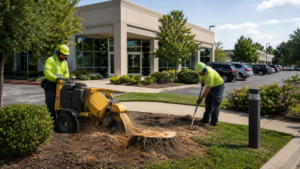
Commercial sites often need predictable access and easier maintenance. A stump within maintained landscaping can complicate mowing throughout summer. During winter, it can complicate snow storage or equipment movement. Stumps near sidewalks may also become difficult for pedestrians to see beneath snow. Removing them helps simplify ongoing grounds maintenance. It can also produce a cleaner appearance for customers, tenants, employees, and visitors.
Could the Stump Attract Insects?
Dead wood naturally becomes part of the decomposition process. Various insects, fungi, and microorganisms help break down woody material. That activity does not automatically mean the stump creates a pest emergency. However, decaying stumps can become less attractive in maintained lawns and landscaped areas. They can also become increasingly soft or hollow over time. Grinding removes much of that visible decaying wood from the property surface.
Fall Stump Grinding Can Simplify Spring Landscaping
Spring landscaping schedules can become busy quickly in Minnesota. Removing the stump during fall eliminates one large obstacle before those projects begin. You can then evaluate settling and soil conditions after winter. That information can help with spring grading, lawn repair, planting, or landscape improvements. The process becomes more deliberate than removing the stump after another project has already started.
Signs It Is Probably Time to Grind the Stump
Walk around the stump and consider how it affects the property today.
- The stump sits near a sidewalk or frequently used path.
- Lawn equipment must repeatedly maneuver around it.
- The stump interferes with snow removal routes.
- You want to reseed or landscape the area next spring.
- New shoots continue growing from the stump or roots.
- The stump creates an unattractive focal point.
- Children, visitors, customers, or employees use the surrounding area.
- The stump occupies valuable space on a small property.
If several conditions apply, grinding may provide meaningful practical value.
What Minnesota Tree Experts Customers Say
“Outstanding work. We had a large tree overhanging our garage, house and power lines that they took down.”
“Difficult to get at due to its location. Jeff and his team took it down leaving hardly any trace.”
“We were amazed that the cleanup was so thorough, we couldn’t tell they had been in the yard.”
“Great to work with, I would highly recommend!”
Finish the Job Before Minnesota Winter Arrives
Removing a tree solves one problem, but the remaining stump can continue affecting your property. Fall gives homeowners and businesses an opportunity to finish the project before snow arrives. Professional stump grinding can improve safety, maintenance access, appearance, and future landscaping options. Minnesota Tree Experts provides comprehensive tree care for residential and commercial properties throughout the Twin Cities area. The company also provides professional tree trimming and pruning, tree removal, storm cleanup, diagnostics, and preventive care.
Visit the Minnesota Tree Experts blog for additional seasonal tree care guidance.
Schedule Stump Grinding Before the Snow Covers It
Do not let an old stump become a hidden obstacle all winter. A professional can evaluate access, stump size, nearby structures, and your plans for the finished area.
Ready to remove an unwanted stump before winter?
Contact Minnesota Tree Experts to request an estimate for stump grinding and professional tree services.

Published September 2026.
Authored by Jacqueline McGreevey & Expert Review by Jacob Gall Owner – Arborist